Connectome Weekly · Issue 4 · Connectopathy
Nov 2 – Nov 8, 2026

Connectopathy cover: a watercolor bonsai and pruning shears
A conversation about autism: what was discovered this week, what we didn’t, and the epilogue thereafter. Calm, careful coverage. No single schema or experience captures everyone, and none of what follows is a cure story.
From the desk
The research articles published this week have steered this ship to discuss the elusive topic of autism. My timeline and exposure to autism have mirrored the public’s similar introduction and embrace over the past 30 years. Today’s more visceral use comes on the back of political agendas, when fear and societal misdirection allow trends like Tylenol (the claimed acetaminophen–autism link, which a study of nearly 2.5 million Swedish siblings did not support) to bear the brunt of the most recent failed misdirection.
That hasn’t stopped researchers and parents alike from fighting restlessly for some sort of answer or direction. Narrowing down to the direct participants of the autistic community, divisiveness exists there as well, with some proposing that ABA has grounds to be called unethical. ABA (applied behavior analysis) is a common therapy that teaches skills by breaking them into small steps and reinforcing progress. Conversely, to many autistic self-advocates and other critics, ABA is not therapy but compliance training: it rewards looking “normal.”
I’ll be candid about something up front. There are questions here I’m intimidated to ask, and part of the reason is that even the process for gathering and judging this evidence doesn’t agree throughout the field. That’s half the trouble of talking about this topic as candidly and openly as possible, so we can push the conversation forward.
The language doesn’t help either. Terms like “fox pruning” are catchy, and catchy can promise more than the paper supports. That’s not to demean anybody’s research. But there is a bit of sleight of hand between the results and the extrapolation, and you see it once you get into the research paper itself. If we’re going to address these topics with the seriousness that publishing deserves, we have to demand transparency in all facets.
This issue is meant to be a conversation, not a verdict. What did we find? Does it lead anywhere? Is there a question in it? Did we move an inch or a mile?
This week’s episode: “Understanding Is Not a Sound”
Brandon, Dr. Priya (a speech-language pathologist) and Axon visit a quiet playroom, wait for speech, and miss a girl who’s been asking for the ball the whole time. “She did. You were watching the wrong channel.” Ten panels, no claims about any one person.
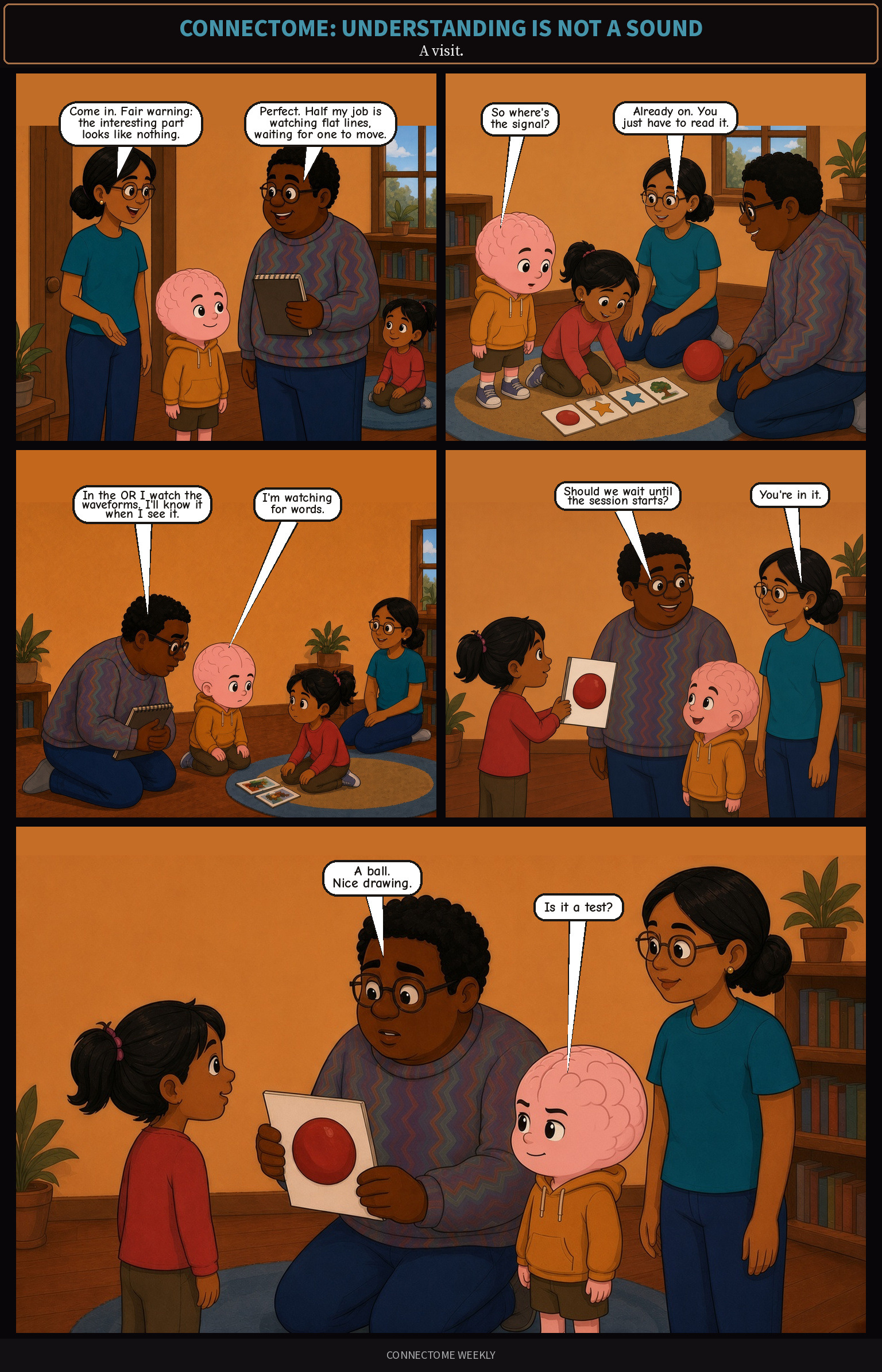
Page 1: Brandon, Dr. Priya and Axon in a playroom; a girl asks for the ball.
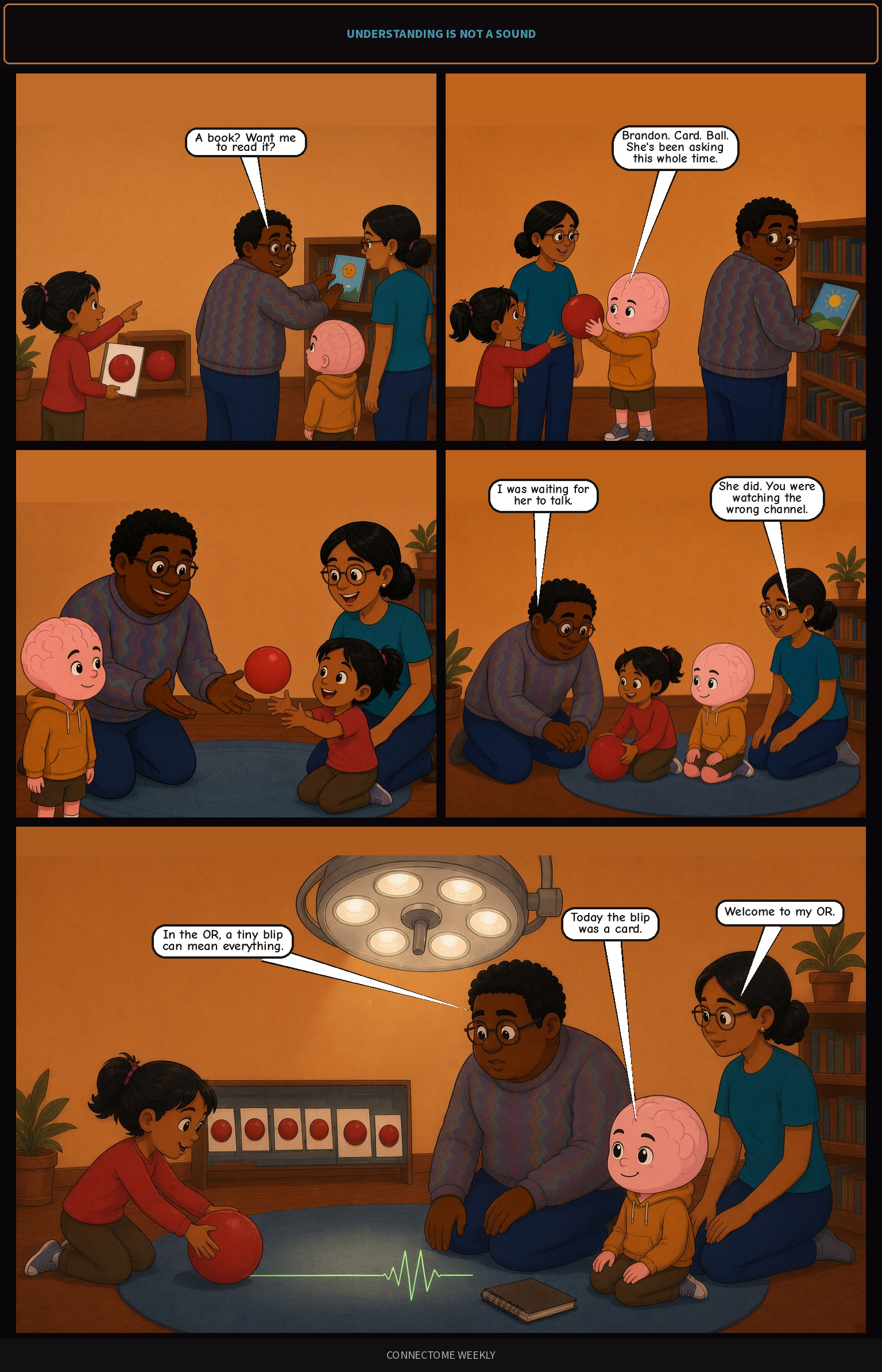
Page 2: Understanding Is Not a Sound, continued.
Connectopathy
Connectopathy means a disorder of brain connectivity: the idea that autism reflects differences in how brain regions wire to and talk with one another, rather than a problem in any single region. It isn’t a diagnosis. The idea traces to Geschwind and Levitt (2007), who described autism spectrum disorders as “developmental disconnection syndromes,” in which higher-order regions, especially frontal and temporal cortex, don’t wire together typically.
What we found: three papers
1. Omega-3 DHA and inflammation.
Xu et al., Pediatric Discovery, Oct 1, 2026. Young rats separated from their mothers 3 hours a day (days 1–21) and then housed alone showed what the authors call autism-like behavior; it is a stress model, not a genetic one. DHA, injected into the abdomen at 80 mg/kg/day, improved sociability, grooming and avoidance and lowered inflammatory signals (JNK, TNF-α, IL-6, IL-1β) in prefrontal cortex. The open threads: whether the inflammation drives the behavior (here the two move together), and how this carries to people, where omega-3 trials have changed blood fatty acids without a clear clinical benefit so far (Cochrane found insufficient evidence). I also dislike “eases autism behaviors” as a headline. Which behaviors anyone should want eased is a question for autistic people and their families.
2. One mutation, a whole network.
Andersen et al., Nature, Nov 2, 2026. In human neural progenitor cells, disturbing any one of 18 autism-associated genes produced overlapping changes, including widespread downregulation of other autism genes. CHD8 sat among the central regulators. The X-linked factor ZFX is proposed to help explain why autism is diagnosed more often in males. “Collapse” is the headline’s word; the paper says downregulation. What matters is the convergence: many genetic starting points feeding one shared program gives research a target to build from. That also fits the broader genetic picture: highly penetrant mutations exist, including in CHD8, but most of the risk is spread across many common variants of small effect (Sanders et al., Neuron, 2015).
3. Feedback, not raw perception.
Zuk et al., Journal of Neuroscience, October 2026. About 33 autistic and 35 non-autistic adults judged which of two tones was higher and then saw whether they were right, with EEG recording. Accuracy was similar in both groups. What differed was evaluation: a smaller feedback-related negativity (the brain’s electrical response to “wrong”), feedback responses that varied less with difficulty, and less adjusting after easy correct trials. The three differences were replicated in a follow-up 1–2 years later (51 participants, a mix of returning and new people), and combined they sorted the groups with about 80% accuracy; the authors stress this is not a diagnostic tool. (Group sizes are approximate, per the university press release.) The next step is other labs and other tasks.
How they fit.
Gene, cell and circuit-level behavior: three different levels, and no single study joins them. I think there is a line, though, and here is my attempt to draw it. Andersen’s cells show that disturbing one autism gene shifts many others, so very different genetic starting points could funnel into a shared program. If that program shapes how synapses form and get trimmed (Chen’s mice, below, tie the autism gene SETDB1 to how much microglia prune), the result would be a difference in wiring: the connectopathy. Xu’s rats suggest inflammation in prefrontal cortex is one lever on that system that can actually be moved. And Zuk’s adults show where a wiring difference might surface: not in hearing the tones, but in how the brain evaluates feedback, a signal usually traced to the medial frontal cortex. Gene network, wiring, evaluation. It’s an extrapolation, not a finding, but each link can be tested, and that is how this moves from a newsletter to research.
Too much or too little?
I didn’t know pruning could go wrong in two directions. I came at this the way a student does, by asking: if the developing brain trims synapses as it grows, can that trimming miss in more than one way? As it was explained to me, yes. Too little, or too much.
Too little. In postmortem temporal cortex, spine density fell about 45% from childhood to adolescence and young adulthood in controls, but only about 16% in autistic donors (Tang et al., Neuron, 2014). Hutsler & Zhang (2010) also found higher spine density.
Too much. In mice, SETDB1 loss or maternal immune activation raised complement C4b and drove excess microglial synapse pruning; knocking out C4b rescued the behaviors (Chen et al., Neuron, 2026). Omega-3 deficiency also increased microglial synapse engulfment in mice (Madore et al., Nature Communications, 2020).
Both directions are reported, in different species, ages and models. That is a candid answer, not a tidy one. It may be exactly why every autistic instance should be investigated in research, somehow, for too much or too little: different people may be on different routes. The thermostat picture I keep reaching for, a system that overshoots, fits the mouse data. The human tissue points the other way. Human imaging also finds microglia more active than usual: Suzuki and colleagues (JAMA Psychiatry, 2013), using PET in young autistic adults, saw excess activation in several regions, most prominently the cerebellum. A longer-standing model (Bilbo & Schwarz, 2012) is that an early-life immune challenge can activate microglia and change later wiring, including how synapses are pruned.
That’s what took me to the fox paper.
Where “pruning” came from: the foxes
Decades of selecting silver foxes for tameness (Belyaev, from 1959) led to the fox lines in a new study: Klein et al., Current Biology, Nov 2, 2026, found fewer estrogen-receptor neurons in one hypothalamic region (VMHvl) of tame lines than aggressive lines. Fewer cells could explain the tameness. What the study shows is an association across bred lines; whether the cells were never made, were lost, or moved isn’t shown yet. “Pruned” is the headline’s word, not the paper’s.
A few other environmental associations are on firmer ground than others, and still aren’t “the cause.” Prenatal valproate is among the clearest: 4.4% of exposed children were diagnosed with autism versus 1.5% unexposed (Christensen et al., 2013). Prenatal PM2.5 air pollution was associated with higher odds of autism in a Nurses’ Health Study analysis (Raz et al., 2015). Acetaminophen is the one in the headlines: a Danish cohort (Liew et al., 2016) found an association only when autism came with hyperkinetic symptoms; the later Swedish sibling comparison did not support a link.
Did we gain an inch or a mile?
An inch, maybe a few. Depends on how long you plan on running the race, or what your definition of a race is.
The three papers are each real at their own level, and none changes what happens for an autistic person today. What they give us is better questions: why one gene disturbs many, where evaluation, not perception, differs, and whether an inflammation lever is worth testing carefully.
Axon’s Findings
Axon is the guide from our comic. In this section he rounds up a few papers from the week that didn’t make the main story but are worth a minute: one or two lines each, with a link if you want the full read.
1. Psilocybin, one dose, mice. Five labs found no reproducible drop in anxiety- or depression-like behavior at 24 hours; the acute effects replicated. Lu et al., Nature Neuroscience · Neuroscience News
2. Pink noise in conversation. The conversations people enjoyed most drifted apart and back together in meaning at a 1/f rhythm. It rhymes with the comic. O’Nell, Sanchez & Finn, Science Advances · Neuroscience News
3. Hearing loss and the periphery (mice). Visual cortex got quieter to peripheral stimuli, and the mice saw the periphery more clearly. Pham et al., J Neurosci · Neuroscience News
4. Octopus memory without new proteins. A self-reactivating nitric-oxide loop holds long-term potentiation in place. Turchetti-Maia et al., J Neurosci · Neuroscience News
— Brandon Garrison
Sources. Geschwind & Levitt, Curr Opin Neurobiol 2007, doi:10.1016/j.conb.2007.01.009 · Ahlqvist et al., JAMA 2024, doi:10.1001/jama.2024.3172 · Xu et al., Pediatric Discovery 2026, doi:10.1002/pdi3.91 · Cochrane, omega-3 for ASD · Andersen et al., Nature 2026, doi:10.1038/s41586-026-11236-6 · Sanders SJ et al., Neuron 2015, doi:10.1016/j.neuron.2015.09.016 · Zuk et al., J Neurosci 2026, doi:10.1523/JNEUROSCI.0315-26.2026 · Belyaev DK, J Hered 1979 (farm-fox experiment begun 1959), doi:10.1093/oxfordjournals.jhered.a109263 · Klein et al., Current Biology 2026, doi:10.1016/j.cub.2026.09.020 · Tang G et al., Neuron 2014, PMC4159743 · Hutsler & Zhang, Brain Res 2010, doi:10.1016/j.brainres.2009.09.120 · Chen S et al., Neuron 2026, doi:10.1016/j.neuron.2026.01.011 · Madore C et al., Nat Commun 2020, doi:10.1038/s41467-020-19861-z · Suzuki K et al., JAMA Psychiatry 2013, doi:10.1001/jamapsychiatry.2013.272 · Christensen J et al., JAMA 2013, doi:10.1001/jama.2013.2270 · Raz R et al., Environ Health Perspect 2015, doi:10.1289/ehp.1408133 · Liew Z et al., Autism Res 2016, doi:10.1002/aur.1591 · Bilbo SD & Schwarz JM, Front Neuroendocrinol 2012, doi:10.1016/j.yfrne.2012.08.006 · Lu et al., Nat Neurosci 2026, doi:10.1038/s41593-026-02500-z · O’Nell, Sanchez & Finn, Sci Adv 2026, doi:10.1126/sciadv.aeb2684 · Pham et al., J Neurosci 2026, doi:10.1523/JNEUROSCI.0690-26.2026 · Turchetti-Maia et al., J Neurosci 2026, doi:10.1523/JNEUROSCI.1676-25.2026