Connectome Weekly · Issue 6 · Slow Waves, Wide Awake
Nov 17 – Nov 22, 2026
This week’s episode: “Slow Waves, Wide Awake”
Axon finds Brandon nodding off at a dance-pad marathon, and it gets them talking about sleep-like waves in a wide-awake brain.
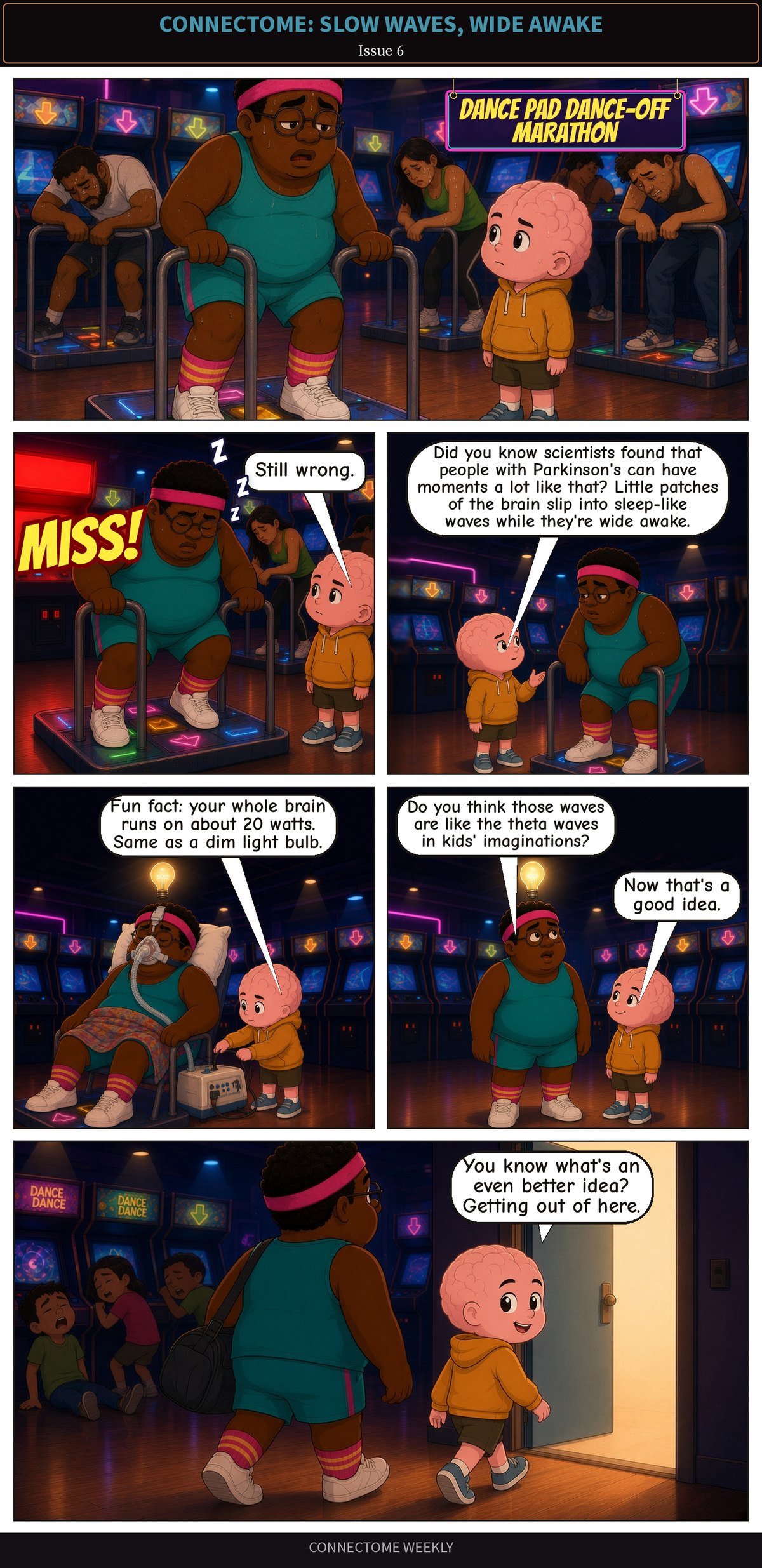
Inspired by this week’s lead.
Words to know this week
- Theta: A slower brain wave, about 4 to 10 beats per second. In young children, it often shows up as the quiet background rhythm at the back of the head. In adults, it shows up more when we are learning, remembering, or catching a mistake.
- Thalamus: A deep hub that passes messages between the senses, the body, and the rest of the brain. It is one of the busiest intersections in the wiring.
- Sleep-like slow waves: Even slower than theta, usually seen in deep sleep. In this week’s Parkinson’s paper, waves like these showed up while people were awake.
- Blood-brain barrier: A tight lining in the brain’s blood vessels that decides what may enter from the blood, and what must stay out.
- Mini-brains: Tiny clusters of living human brain cells grown in a dish, used to watch early brain development up close.
- Microglia: The brain’s cleanup and security crew. They roam the tissue, clear debris, and try to wall off harmful clumps.
- Plaques: Sticky leftover protein clumps that build up in Alzheimer’s. The cleanup crew tries to pack them tight so they do less harm.
1. Slow Waves, Wide Awake
When I first read the multiple sclerosis paper about the thalamus shrinking over time, I immediately tried to find non-invasive ways to stimulate the thalamus, repeatedly, over time, just like my unfortunate obsession with TMS therapy (transcranial magnetic stimulation). I remember a study where healthy volunteers were given an artificial sense of touch, using mild electrical pulses sent through the skin to the nerves in their forearm. Normally that kind of feeling slowly fades, but with 5-second bursts and 40-second rests, the feeling held steady for 45 minutes, the brain’s response never faded, and over time it spread beyond the brain’s main touch area into a wider network. Stimulating an area can wake it up and may even help grow new branches between nerve cells, possibly alongside other treatments. Areas that have gone quiet have answered outside stimulation before, so why couldn’t that idea help in multiple sclerosis, or in Parkinson’s?
Armed with that question, I kept searching the research and stumbled on a study showing that people with Parkinson’s get daytime bursts of sleep-like waves while they’re wide awake. I took the liberty of assuming the drop from busy, awake beta waves down to slow delta waves is gradual, not an instant shift. Theta is a rhythm the brain has to pass through on the way down. I wonder if some of the hallucinations come from lingering in that theta band, the same rhythm tied to the dreamy, imaginative state kids live in between about ages 4 and 7, before it gets replaced by the busier rhythms of grown-up life.
Back in Issue 1, we learned that gamma and theta are coupled, locked together like gears. When gamma gets thrown off, theta feels it too. So the slow-down in this week’s studies may be part of a bigger chain. This isn’t meant to downplay how harmful Parkinson’s is. It’s just a hopeful look at what’s recently been found in the research.
Thoughts from the OR
In my field, we run a test called an SSEP, short for somatosensory evoked potential. We gently stimulate a nerve, usually at the wrist or ankle, and record how that signal travels up through the spinal cord and into the brain. It’s one of the main ways we keep watch over a patient’s sense of touch during surgery, and the same test is used in outpatient clinics, for example when doctors check for signs of multiple sclerosis.
Some of our recording spots sit right on top of where the signal is happening. Others pick it up from a few centimeters away and average it out. Along that route, the thalamus is one of the major relay stations we watch, both in clinic and in the OR. That makes me wonder: if we tracked the thalamus part of that signal over time, could it become an extra clue for spotting multiple sclerosis, or even Parkinson’s, earlier? That’s my own idea, not something these studies tested, but the data is already being collected every day.
2. Boosting Before Birth
Instead of cutting DNA, a research team used a gentler CRISPR tool as a volume knob. They turned up the cells’ own healthy copy of two autism-linked genes in lab-grown human neurons and mini-brains, and the boost switched on only in the cells carrying the mutation. In one model, the overgrowth eased and the cells matured more typically; in the other, more typical electrical firing came back.
Here is where my mind went. In the dish, turning up the healthy copy kept the cells from building the atypical wiring pattern the mutation was steering them toward. So what if that volume knob could be turned early, at the right window before birth, almost like a preventive booster? Another recent paper on the blood-brain barrier showed that the door into the brain is choosier than we thought, and that some things made in the body do get through. That study wasn’t about gene therapy or pregnancy, but it makes me wonder who will figure out that door.
To be honest about the distance: all of this was done in a dish, nothing has been tested in pregnancy or in any animal for this purpose, and a rat model would be my very next step for replication. Still, in an age of overpromised health and wellness, a careful venture focused on women’s health and research, built on the shoulders of work like this, is one I can see becoming real.
To simply entertain this idea, reply to this email or message me on LinkedIn.
3. The Question Before Birth
Scientists mapped how DNA is folded and marked inside a deep brain area that handles movement, habit, and reward, from mid-pregnancy into infancy. One cell type, a kind of neuron that sends signals out of that region, carries a heavy share of the inherited risk for schizophrenia, and some of the risk for bipolar disorder. The tissue came from typical development, so this marks a time and a place where risk may act; it does not say those cells cause illness, and nothing here was erased or treated.
Which leaves the harder part, and I will just hand it to you.
If that risk can be seen this early, how would you answer the question if it were posed to you in the future? Or would we answer to it, as a necessary protocol for a healthy newborn? Where is your line drawn? And could your environment dictate whether you are even able to make that choice at all?
4. The Brain’s Trash Compactor
Before we get into this one, here’s the main takeaway: sleep is one of the brain’s best cleanup tools. Studies, mostly in mice, suggest that during deep sleep, fluid flows through the brain and rinses out waste, helped along by tiny water gates called aquaporin-4. That’s why a steady sleep schedule and a healthy body clock are part of the brain’s waste management. When the cleanup falls behind, junk can build up and clog things.
A gene tied to Alzheimer’s risk, called CASS4, turns out to do its work in microglia, the brain’s cleanup crew, not in the nerve cells themselves. When scientists removed it in mice, the cleanup crew got worse at reaching sticky plaques, packing them tight and walling them off, so the plaques spread and thinking got worse. This was in mice only, so it isn’t a test or a treatment, but it shows that some Alzheimer’s risk may run through the crew that takes out the trash.
As soon as I saw this paper, I thought of the outstanding work of Patrick Woller. He was a colleague of mine in undergrad at Baldwin Wallace University, and his work on aquaporin-4 channels and tau in rats fed a high-fructose diet brought back memories. Comparing what they’ve seen with what we noted in our research makes me very proud of the work Patrick is doing now. Since then, Patrick earned his PhD in neuroscience, where he studied how epilepsy can disrupt breathing, and today he helps run clinical trials for brain and nervous system treatments.
Here’s the connection. Aquaporin-4 is a water gate on star-shaped support cells called astrocytes. It lets fluid wash through the brain and rinse out waste, kind of like a dishwasher that runs while you sleep. CASS4 helps a different helper cell squash and seal up the garbage. Both papers say the same big thing: the brain’s helper cells, not just its nerve cells, decide how well the trash gets handled. Patrick asked whether a high-sugar diet changes where those water gates sit and how much tau builds up, while this new study removed a risk gene and watched plaques.
I push anyone to keep going with their research and pursue their passions and dreams. You never know where in the world your visions can take you.
So tonight, give your cleanup crew a head start, and get some sleep.
Research credits
- Multiple Sclerosis Atrophy Spreads From High-Stress Neural Hubs: Research led by Mar Barrantes-Cepas, with senior author Giuseppe Pontillo (Amsterdam UMC), published in Science Advances. DOI: 10.1126/sciadv.aeg3412
- Daytime Sleep Waves in Parkinson’s Linked to Hallucinations: Research led by Dr. Fosco Bernasconi, with senior author Olaf Blanke (EPFL), published in Science Translational Medicine. DOI: 10.1126/scitranslmed.aec1215
- Brain Moves Its Touch Center to Keep Feeling Sensation: Research led by Dr. Susan Coltman, with senior author Dr. Xiaogang Hu (Penn State), published in IEEE Transactions on Medical Imaging. DOI: 10.1109/TMI.2026.3738278
- CRISPR Enhancer Editing Rescues Autism Brain Organoids: Research led by Dr. George Chen, with senior author Dr. Daniel Geschwind (UCLA), published in Nature Neuroscience. DOI: 10.1038/s41593-026-02504-9
- Blood-Brain Barrier Protein Atlas Unlocks Alzheimer’s: Research led by Haoyue Zhou, with senior author Dr. Andrew Yang (Gladstone Institutes), published in Cell. DOI: 10.1016/j.cell.2026.10.039
- 3D Genome Atlas Reveals Early Roots of Schizophrenia: Research led by Matthew G. Heffel, with senior author Chongyuan Luo (UCLA), published in Cell. DOI: 10.1016/j.cell.2026.10.008
- CASS4 Gene Directs Microglia to Contain Alzheimer’s Plaques: Research led by Adeline E. Walsh, with senior author Dr. John Lukens (University of Virginia), published in the Journal of Experimental Medicine. DOI: 10.1084/jem.20260104
- Aquaporin-4 Distribution Correlates to Increase in Tau Accumulation in Sprague Dawley Rats Fed a High Fructose Diet: Research by Patrick G. Woller, with advisor Dr. Jacqueline Morris (Baldwin Wallace University), published in the Ohio Space Grant Consortium 2019–2020 Student Journal, page 15.
— Brandon Garrison