Connectome Weekly · Issue 2 · The Flooded Chamber
Oct 19 – Oct 25, 2026
This week is about the quiet crews — the parts of us, and of the brain, that carry the heavy load without anyone noticing: the empathy that can hold you up or pull you under, a cold-sore virus nudging the brain's cleanup cells, sound steered through an intact skull to calm delusions, a "background" cell that turns out to be a builder, and an AI learning to read the whole brain at once.
This week's episode: "The Flooded Chamber"
Brandon and Axon dive into the brain. The real science behind it is below.
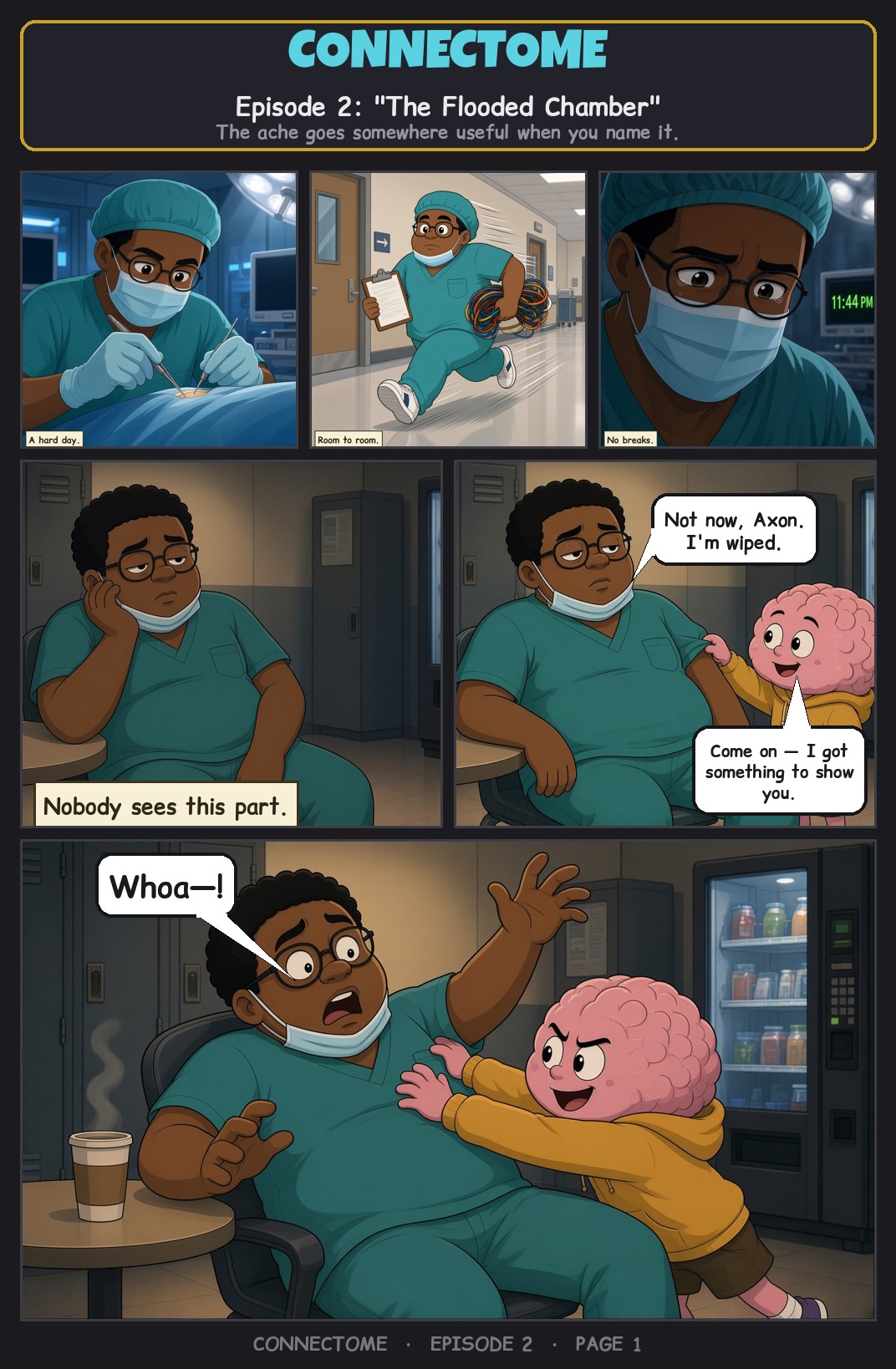
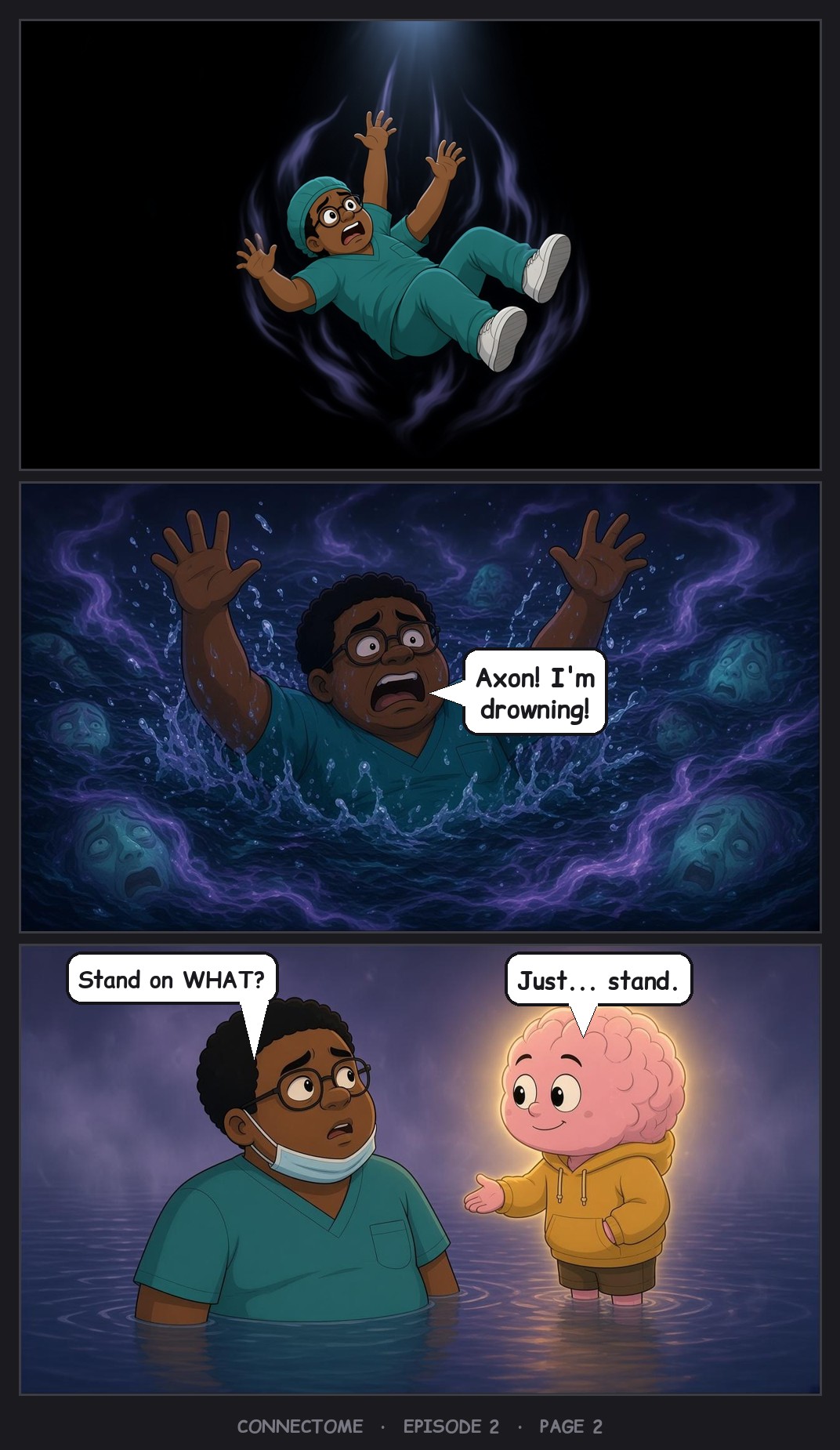
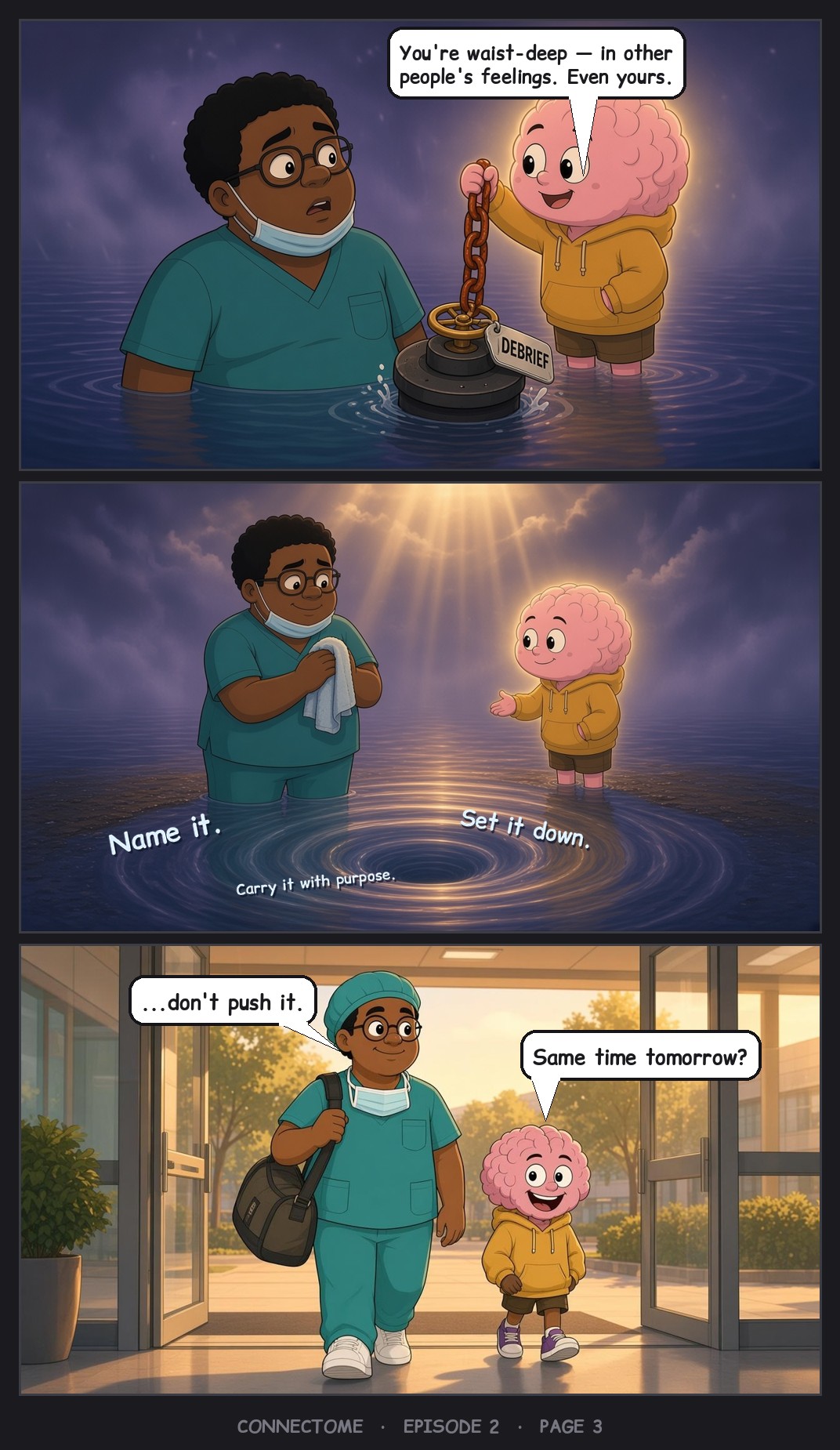
Comic credits: Inspired by the lead study — Dana Katsoty, Anthony D. Mancini & Ariel Knafo-Noam, Clinical Psychological Science (2026).
The lead
If you feel everyone's pain, read this first
Five ways to debrief — for the people who carry other people's worst days
Let's have the honest conversation we don't usually get to have. So many of us work in rooms where people look to us with everything on the line, and we're the ones who have to hold composure. We don't get to flinch — and because the job asks for that face, a lot of us end up feeling almost guilty for needing to put it down afterward. Don't. The strength was real; this is just the other half of it, the part nobody sees and the part that keeps you in the game. You come home still holding the patient on the table, the kid who broke down in third period, the crisis you couldn't put down. Feeling the room is a gift — and new research says it might also be a risk. Here's how to keep the gift without paying for it.
1. Dose your exposure. You can't pour from an empty cup, but you also can't stand in the rain all day. Space out the heavy cases when you can. Back-to-back trauma with no gap is how empathy turns into injury.
2. Debrief instead of swallowing. After a hard case, say it out loud to someone — a colleague, a partner, a voice memo to yourself. The stuff you don't process doesn't disappear; it just goes underground.
3. Name whose pain it is. "That's their pain, not mine." It sounds small. It's the difference between feeling with someone and drowning as them.
4. Convert the ache into action. The ache that just sits there wears you down. The ache you turn into a next step — a call, a fix, a kindness — becomes compassion instead of distress. Other research suggests that shift can help, though this study didn't test it.
5. Know your environments. If you're the high-empathy type, some rooms cost you more. Knowing that in advance isn't weakness. It's a flight plan.
The one line that keeps all of this honest: feel with people, don't drown with them.
The research behind it
That "risky strength" idea isn't a hunch — it fell out of one of the most careful trauma studies I've seen.
The study. Katsoty and colleagues followed 1,035 Israeli adults across six months after the October 7th attacks, checking in three times — around two weeks, seven weeks, and six months. Instead of asking "do they have PTSD or not," they tracked how people moved over time.
Four paths emerged:
- Resilience — 54.5%. Steady, held together throughout.
- Recovery — 29.1%. Hit hard early, climbed back out.
- Chronic distress — 13.9%. Struggled and stayed struggling.
- Delayed onset — 2.5%. Looked fine at first, then slid.
The empathy paradox. People higher in emotional empathy — the automatic resonance with others' pain — had more distress and worse trajectories. That held whether they absorbed the pain (empathic distress) or cared about the person (empathic concern), though empathic concern also came with more social support and volunteering. So empathy can be a burden and an asset at once. (Honesty note: the idea that turning distress into compassion actually protects you comes from separate research, not from this study.)
- Watch the movie, not the photo. A single screening misses people — especially that delayed-onset 2.5%. Change over time is the real signal.
- Early distress ≠ doom. Nearly a third got slammed early and still recovered.
Dana Katsoty, Anthony D. Mancini & Ariel Knafo-Noam (Hebrew University of Jerusalem, Columbia University, Pace University), Clinical Psychological Science (Oct 1, 2026), open access. DOI: 10.1177/21677026261479652. Via Neuroscience News.
Story two
What if a lifetime of cold-sore flare-ups leaves the brain's cleanup crew stuck in fight mode?
And when that crew is busy fighting, the clearance that normally helps keep Alzheimer's away gets weaker. That's one possible route into Alzheimer's, and it's the question this study puts on the table.
More than 60% of adults carry the cold-sore virus, HSV-1, for life. It usually sits quietly in the nerves of the face. Researchers have suspected for years that it has something to do with Alzheimer's, but nobody had mapped what it actually does to the brain's immune cells.
What the study did (in mice). A team at CU Anschutz gave mice a mild HSV-1 infection through the nose and looked at their brains 6 days later. The virus showed up in a specific spot in the brainstem, the spinal trigeminal nucleus, which is where the face's sensory nerve plugs in. In those spots, the microglia (the brain's resident immune cells, its security system and maintenance crew in one) switched into an antiviral emergency mode driven by interferon. At the same time they turned down their everyday housekeeping genes, including ApoE, a gene tied to Alzheimer's risk. The virus also changed how the cells' DNA was packaged, which hints the change goes deeper than ordinary inflammation.
Why that matters. That "fight mode, not maintenance mode" pattern looks a lot like the microglia patterns seen with aging and with Alzheimer's risk genes.
What it doesn't show. This was mice, at one acute time point, 6 days in. I'm not going to stretch 6 days in a mouse into a lifetime in a person. The researchers say it themselves:
"Although we have not established that HSV-1 causes Alzheimer's, it highlights the immune programming of microglia as a common factor linking infection, aging and genetic risk factors." — Kimberley Bruce, PhD, co-senior author
What we can say about people is narrower. Most adults carry this virus for life, and clinical and population studies have linked HSV-1 to brain inflammation and Alzheimer's. This study gives a possible mechanism for that link. It isn't proof.
The open question is the one I started with. The team's next step is to test whether these changes become permanent, and how repeated flare-ups over decades affect the brain. In the senior author's words:
"An important question is whether these changes persist after infection." — Christy Niemeyer, PhD, senior author
If the answer is yes, every cold sore might be a small withdrawal from the brain's maintenance budget. That's worth knowing.
Frietze S, Lunn C, … Bruce KD, Niemeyer CS (University of Colorado Anschutz). "Intranasal HSV-1 infection drives region-specific interferon-dominant microglial remodeling." PLOS Pathogens (Oct 1, 2026), open access. DOI: 10.1371/journal.ppat.1014684. Via Neuroscience News.
Spotlight
They aimed ultrasound through an intact skull — and delusions dropped
This one's a genuinely high-profile result, and it stands on its own. In a recent sham-controlled study, a single session of transcranial ultrasound tuned a deep brain circuit tied to psychosis and dropped patients' delusions — no surgery, no incision, energy aimed through an intact skull. In the researchers' own words:
"Our results offer early evidence that a single session of transcranial ultrasound stimulation can safely 'tune' a brain circuit linked to psychosis and lead to a noticeable drop in delusions." — Wei Qi, MD, lead author
And on precision, which is the hard part when the target is small and deep:
"Unlike other emerging techniques that modulate brain circuits, transcranial ultrasound stimulation offers a unique opportunity to precisely target very small regions that affect thinking and behavior." — Shy Shoham, PhD, co-senior author, NYU Grossman School of Medicine
Two things stuck with me. First, it lasted: the drop in delusion severity held across the entire seven-day window after treatment — one session, days of benefit. Second, it was gentle: the side effects — a passing headache, mild fatigue, brief fluctuations in distress — were minor, self-limiting, and no different from the sham group. Energy you can aim, that does something real, sticks for days, and doesn't tear anything up.
Qi W, Gilad A, Santacatterina M, … Shoham S, Goff DC. "Transcranial ultrasound stimulation of the right globus pallidus interna in schizophrenia: A randomized, sham-controlled pilot study." npj Acoustics (Oct 20, 2026). DOI: 10.1038/s44384-026-00076-3. ClinicalTrials.gov NCT05643196. NYU Langone write-up.
Where my head goes with this (an extrapolation, not a finding)
If you can aim energy through the skull and tune one small deep circuit, I keep landing on a different target: the lateral habenula, the brain's "anti-reward" switch. In treatment-resistant depression it fires too hard — it clamps down on reward and mood and won't let go, and we know that's causal, not just correlation. Small early deep-brain-stimulation studies — a handful of patients each — have eased depression when surgeons reach it directly. The problem has always been getting there without surgery.
So here's the approach I'd love to see tested — and as far as we can find, nobody has tried it in people yet. Two energies, two axes, aimed at the same spot. First, steerable focused ultrasound from the front of the head — the same tool that just tuned a psychosis circuit — parked on a target millimeters wide, deep inside. Second, temporal interference: two high-frequency electric fields crossing through the skull, tuned so that only where they cross — deep at the habenula — does a slow rhythm emerge that neurons respond to. In people, temporal interference has reached the hippocampus and striatum this way; the habenula would be a new target. Point both at the overactive habenula, tune them to suppress rather than excite, and the goal is simple: turn the switch down, let reward and mood come back online — and because it's energy, not a lesion, it's reversible.
To be clear, this is my extrapolation. The psychosis study proves the method works in humans; the habenula version is untested. It's the strongest noninvasive candidate I can find — and it's still just sitting there. Here's roughly what it would look like from above:
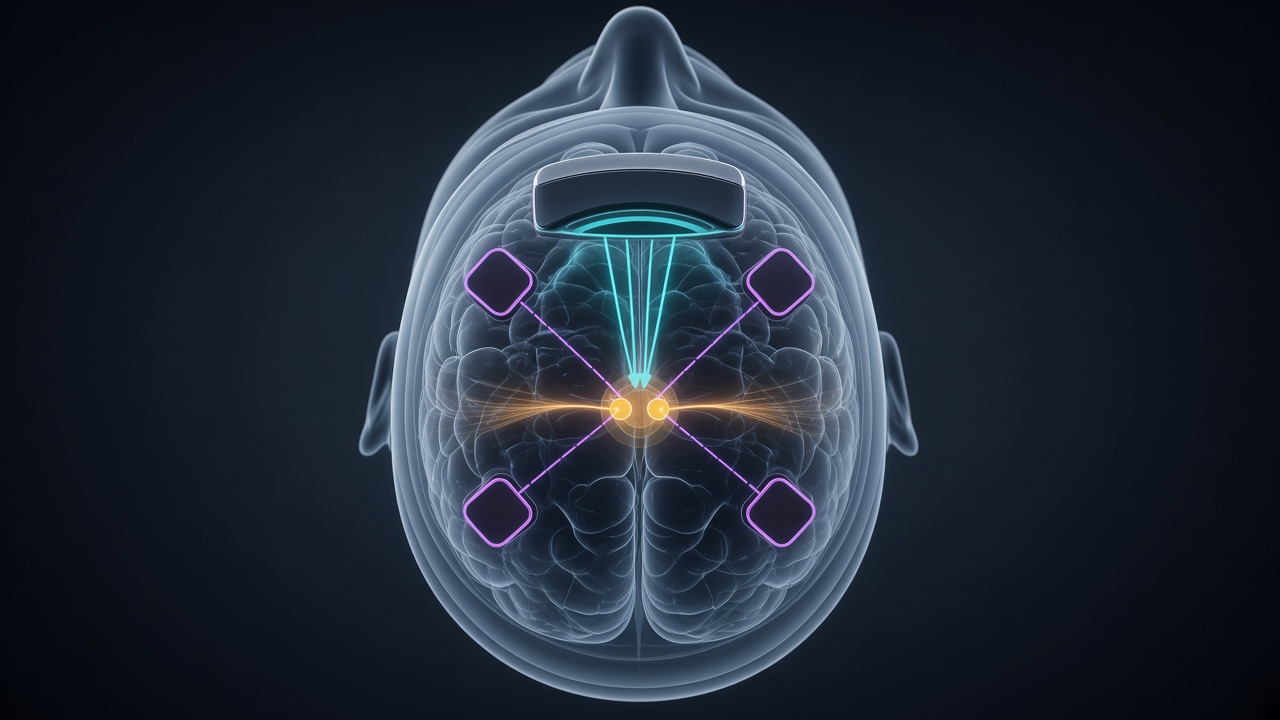
Top-down view, looking over the patient's head: steerable focused ultrasound at the front (blue) and four temporal-interference pads (purple) all aimed at the gold lateral habenula near the center. An illustration of a proposed, untested approach — not a result.
The cell of the week: meet the CD51+ astrocyte
A support cell that turns out to be a builder
For a hundred years we treated astrocytes — the star-shaped cells that outnumber neurons — as the brain's background crew: feed the neurons, hold the blood-brain barrier, keep the lights on. A new study in Nature from Benjamin Deneen's lab at Baylor says that's wrong. Astrocytes come in specialized subtypes with real jobs, just like neurons do.
The team built new mouse tools to sort astrocytes by a surface marker called CD51, then watched what each group actually did in living brains.
What the CD51+ astrocytes do:
- They build synapses. In the cortex, CD51+ astrocytes assemble the junctions where neurons talk, using a protein called glypican 6. The CD51-negative ones don't do this at all.
- They tune memory circuits. In the hippocampus, they drive the rewiring behind learning and memory — and here the CD51 protein itself does the work, not a secreted factor.
- They lead repair after stroke. After an ischemic stroke, CD51+ astrocytes migrate to the damaged edge and rebuild circuits to bring motor function back. The CD51-negative ones don't.
Why it matters. This is a new way to think about the brain's support cells, and a new handle for therapy. Instead of broad glia-targeting drugs, future treatments for memory disorders, developmental delays or stroke rehab might aim specifically at CD51+ astrocytes to speed up rewiring. As Deneen puts it, studies of astrocytes "will need to consider which subtypes are involved."
Worth keeping honest: this is a mouse study, and the therapy angle is a direction it opens, not something tested in people yet.
Woo J, Williamson M, … Deneen B (Baylor College of Medicine), Nature (2026). DOI: 10.1038/s41586-026-11186-z. Via Neuroscience News.
The last word: an AI toolkit for the whole brain-imaging pipeline
UniBrain wants to turn raw scans into answers you can ask in plain language
Here's the one to watch rather than the one that's done. A team led by Lehigh University just won a 4-year, $2.8M NIH grant to build UniBrain, an end-to-end AI toolkit for neuroimaging. Today, getting from a raw MRI to a usable biomarker runs through a chain of separate tools — motion correction, registration, skull stripping, segmentation, connectome mapping, classification — and for big studies that can take weeks, with errors stacking up along the way.
UniBrain's pitch is to fold all of that into unified deep-learning pipelines, and to put a conversational layer on top: a clinician or researcher uploads a scan, asks a question in plain English, and gets back an interpretable report with the parts of the brain that drove the answer highlighted. The goal, in the team's words, is "an accessible, standardized foundation for precision neurology and translational neuroscience."
Why standardizing this matters: when 70 independent teams analyzed the same brain-imaging dataset, their conclusions varied a lot, mostly because of the analysis choices each team made (Botvinik-Nezer et al., Nature 2020). A shared pipeline could take some of that luck out of the result.
The honest part: this is a funded plan, not a published result. There's no peer-reviewed UniBrain paper yet, and "weeks to minutes" comes from early internal tests. The plain-language layer has its own open questions too — AI-written medical explanations often aren't as readable as promised unless you ask for a specific reading level, and grounding answers in trusted sources cuts errors but doesn't erase them. Worth rooting for, worth watching, not yet worth believing on faith.
UniBrain project, led by Lifang He (Lehigh) and Xiang Li (Mass General / Harvard), with sites at Emory and the University of Pittsburgh. NIH NIBIB grant 1R01EB038426-01 (2026–2030). Via Neuroscience News.
Brandon's question of the week
Is your empathy a superpower or a liability — and do you know which environments flip it?
Feel with people. Don't drown with them. However you get there, the whole point was always just to make it home. See you next week.
— Brandon Garrison
Read more and explore the map at connectome.news · connectome.news/connectome
Connectome Weekly · Stories via Neuroscience News. Summaries reflect article reporting; always check the original studies.